

1 Ответ

1. Frank and Laura are brother and sister from New York. Together with their father they are visiting different European countries, including Russia. While in Moscow, they visited several museums. Listen to the dialogue between Laura, Frank and their father in one of the Moscow museums and answer the following questions. You will hear the dialogue twice.
Which European countries did they visit before they came to Moscow?
Ответ: Italy, France, Great Britain
2. Frank really likes …
Michelangelo’s statues.
Egyptian mummies. +
The Legend of Troy.
3. Why did Laura call her brother a “show-off”?
Because he was pretending to be the museum tour guide.
Because he was too happy that their Father was proud of him. +
Because he showed her Michelangelo’s statues David and Moses.
4. Laura knows a lot about …
Michelangelo’s art.
Egyptian mummies.
The Legend of Troy. +
5. The city of Troy was found in the 19thth century by a person from …
Germany. +
Turkey.
Greece.
6. Laura and Frank’s father wanted to see the Gold of Troy because …
he is interested in archaeology.
he enjoyed reading about Troy in his childhood.
for him it was the symbol of a child’s dream come true. +
7. In which museum in Moscow is this dialogue taking place? (Задание со звездочкой * на знание Москвы. 2 балла за правильный ответ.)
The Historical Museum
The Tretyakov Gallery
The Pushkin Museum +
The Darwin Museum
The Moscow Kremlin
The Museum of Archaeology
The Polytechnical Museum
Read an article about the Carnegie Hall in New York and answer questions 1–8 1 – 8 choosing option which best fits according to the text. One of the most famous concert halls in America is the Carnegie Hall in New York. Initially, it was called simply the ‘Music Hall’, but three years after its opening it was renamed in honour of Andrew Carnegie, the man who had provided much of the finance for its building. The Hall officially opened on May 5, 1891. Since then, the Hall has played host to the giants of classical music, as well as those of jazz, pop, folk and rock music, and has also been used for political rallies, religious services and lectures. One of the most dramatic lectures given in the Hall took place during its first year. This began simply as a talk accompanied by slides of paintings of sunsets and landscapes, which was what the audience had been expecting. (сокр.)
8. What do we learn about Andrew Carnegie?
He renamed the Hall.
He felt honoured when the name was changed.
He gave money to help build the Hall. +
He gave most of his money to the Hall.
9. Why was the audience surprised at the lecture in the first year?
People had expected the lecture to be rather more dramatic.
People had not been expecting to see slides.
People thought that the special effects were frightening.
People had thought they were going to hear a straightforward lecture. +
10. What would seem to be special about Yehudi Menuhin’s appearance at the Hall in 1927?
He had not appeared on a stage before.
He was very young at the time. +
He did no practising for the concert at all.
He had played here before.
11. Why do you imagine he went to practise after speaking to the security guard?
He thought the guard would attack him.
He believed what the guard had told him. +
He wanted to find out what the axe was for.
He realised that he needed to practise.
12. Why was the pianist’s answer unhelpful?
The violinist had lost his music.
The pianist was not telling the truth.
The pianist did not know where they were.
The violinist knew he was in the Carnegie Hall. +
13. What happened as a result of the Beatles going to Carnegie Hall?
There were traffic jams in New York. +
There were crowds in all parts of New York.
A few people were seriously injured.
Some people escaped from the Hall uninjured.
14. What happened in the 1950s?
Isaac Stern stopped the demolition of the Hall.
The Hall was sold to the City of New York.
There was a campaign to demolish the Hall.
There was a possibility of the Hall being pulled down. +
15. What does the writer seem to think about the future of the Carnegie Hall.
The greatest entertainers in the world have appeared there.
It will continue to attract great stars. +
It will become a national landmark.
No one can tell what the future will bring
16. For items 1–9, read the text below. Use the word given in brackets to form a new word that fits in the provided space before the brackets. There is an example at the beginning (0). William Shakespeare may be the greatest (0) DRAMATIST (DRAMA) the world has known. He lived in England during the rule of Queen Elizabeth I. It was a time when a (1)Ответ (PLAY) was an important person! Everyone from the queen to the (2)Ответ (POOR) young apprentice loved plays. In fact, a law punished apprentices who sneaked away from work to attend one of London’s theaters. The theater of Shakespeare’s day was an open courtyard. Most (3) Ответ (THEATRE) stood to watch performances. These general-admission spectators were known as “groundlings.”
Only the (4)Ответ (WEALTH) had the money required to buy seats in the covered gallery boxes. The stage had no (5) Ответ (SCENE). It was the dramatist’s task to help the audience imagine the sets. Shakespeare’s (6) Ответ (POET) lines made spectators see a (7)Ответ (MOON) garden, feel the sun, hear the thunder of horses’ hooves. No curtain fell between acts. If a character was killed on stage, the body had to be removed in a way that fit the story. And there were plenty of killings! Shakespeare’s audiences liked action and bloodshed. Every good actor trained to be a swordsman and rehearsed duels. At that time, it was (8) Ответ (PROPER) for women to appear on stage, so boys took the women’s roles. The lovely, romantic Juliet, the treacherous Lady MacBeth, and all of the other female characters were (9) Ответ (CONVINCE) played by well-trained boys.
Ответ:
player
poorest
theatergoers / theatregoers
wealthy
scenery
poetic
moonlit
improper
convincingly
17. For items 11-1010, read the text below and look carefully at each line. Some of the lines are correct, and some have a word which should not be there. If a line is correct put a tick. Use letter “V” as a tick. If a line has a word which should not be there, write the word in a given space. There are two examples at the beginning (0(0 and 00)00).
Ответ:
the
wrote
which
V
out
as
V
the
little
of
18. For items 1–101–10, read the text below and for each gap unscramble the word given in CAPITAL LETTERS. In some cases, a definition of the word is also given. There is an example at the beginning (0)(0).
That name comes from a riverboat term meaning “two fathoms”—a (9) TEDPH of 12 feet. There are many other pen names you might recognize. Children’s writer Dr. Seuss was actually Theodor Seuss Geisel. Lewis Carroll, the creator of Alice in Wonderland, was born Charles Dodgson. Two American mystery writers—Fredric Dannay and Manfred B. Lee—used the pen name Ellery Queen. It can be interesting to think about the story (10)(10) DINEBH a pen name. What name might you select for a pseudonym? Why? (сокра.)
Ответ:
pseudonyms
privacy
discrimination
controversial
masculine
likewise
narrated
assume
firsthand
depth
behind
19. For items 1–51–5, add two letters to the following words to make a new word that fits the definition or synonym. There is an example at the beginning (0).
For items 1–51–5, add two letters to the following words to make a new word that fits the definition or synonym. There is an example at the beginning (0).
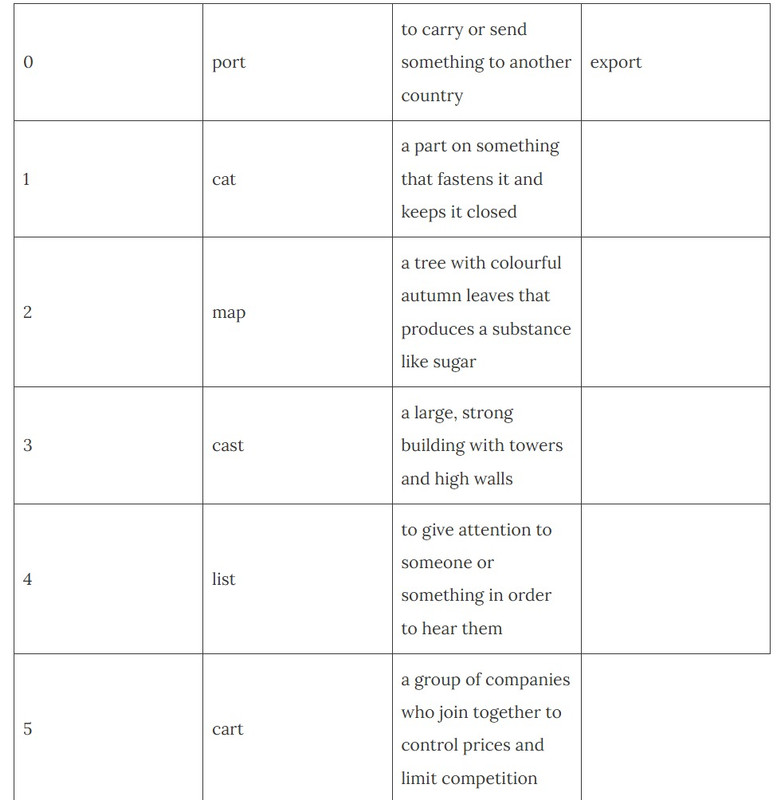
Ответ:
catch
maple
castle
listen
cartel